The Killing Stone
Role: Senior Game Designer
Game: The Killing Stone (single player story-driven deck builder with first person exploration)
Platform: PC (Steam link)
I designed the core card battler rules including the novel "Reserve" system allowing players to stack creatures and buffs for long term planning. I also designed and implemented many of the cards in Lua, built and iterated player and enemy decks, scripted all narrative beats (connecting Unreal 5 Blueprint and Articy: Draft X written content), implemented every tutorial, and built a suite of developer cheats for rapid iteration.
Narrative Design


Malthe's Chapter
As the first character the player must save in TKS, Malthe’s chapter had unique tutorial and story introduction needs. Our Narrative Lead, Jordan Thomas, created a script for TKS’ voice talent, then we discussed the critical path for gameplay. I created a flow in Miro breaking down each beat into art, lighting, code, and design needs. I presented this to the team for feedback, then revised and tasked each outcome.

In Articy I populated content nodes with functional sample text, for example: “Vollem, Malthe's grateful grandfather, reminds the player to sleep upstairs before they can proceed.” This process identifies where players stop understanding what to do next before Narrative commits writing time. The pink node below shows what shipped from that prompt. I used Senior Gameplay Programmer Nick Crosgrove's Articy import pipeline to get the content into Unreal Engine.


I then scripted logic to catch story events in Blueprint. I made a parent class for all family members containing their frob logic. I kept the logic tracking which line a character should say in Articy, cleanly separating “do once” checks only relevant for individual lines from gameplay state.


And with that Vollem speaks! This line repeats if the player continues to interact with him - a signal to continue playing to unlock more dialogue.

For other story beats I built a manager Blueprint that reacts to spatial, cinematic, and card battle triggers from Technical Designer Gretchen Carlson's ritual progression system.
Deck Balance Iteration
In the first weeks after TKS’ early access launch, players reported a unified trend: Enemy decks deal too much direct damage.
Direct damage comes from instant use Invocation cards. Unlike damage from creatures on the board, the player can't see it coming. Armor and dodge tokens can help, but for this context they are passive investments - a defense against a possible outcome, not a satisfying, active rebuttal.
Instead I redesigned and re-implemented many of the direct damage cards to only target assets:


Playtesters reported they were able to focus their builds less on preventative armor and more on their preferred playstyle expression. But now enemy decks built around direct damage (ex: Elite deck Scorched Earth, built around the concept of "deal pain at any cost to myself" ) had a new problem: frequent unplayable hands. Now that their cards required creatures to exist on the board, enemies had to wait for the player to set up a viable board state.
Like many card games with spatial mechanics, it is possible to build inefficient decks in TKS. For example, Chant type cards (typically powerful buffs) can only be played in reserve over Creatures. A chant heavy deck quickly becomes unplayable if there aren't enough Creatures to play them on. To prevent this with enemy decks, the baseline rule was a 2/1 ratio of cards that can be used in any context vs cards that depend on board state to be played. But with the change to target assets rather than the eye, those ratios were in danger.
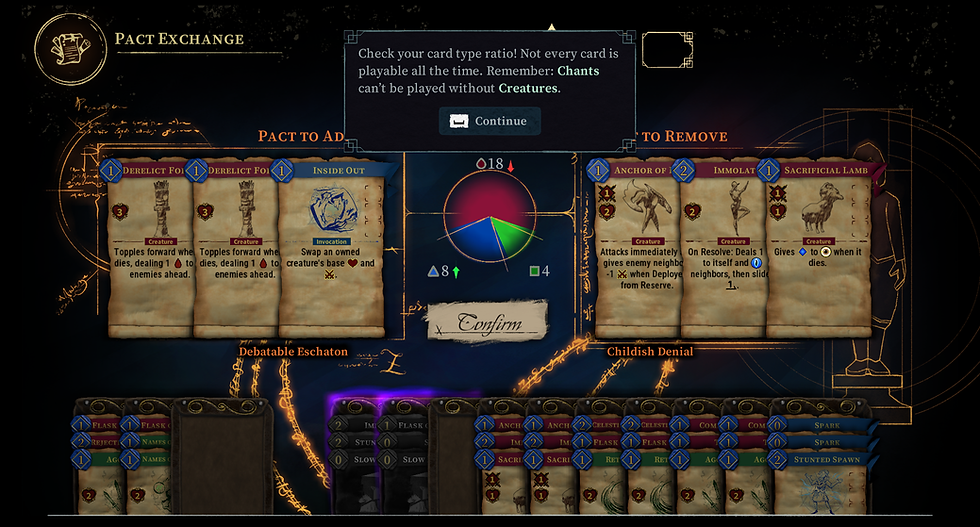
I addressed this by allowing two direct damage cards to target the player directly, but tuned down their frequency in enemy decks. These survivors were Thorns and Spark. Thorns deals 1 damage to all enemy creatures on the board and the eye, so it can be played at any time. The point is to break up the player's side of the board. The longer a card sticks around, the more damage it's dealing, shots it's blocking, and buffs it's accruing from Chants. So enemies need tools get rid of big blockages. But it is moderately expensive to play, so this low - but - wide damage card might take out defenses, but the demon can't do much else after playing it.
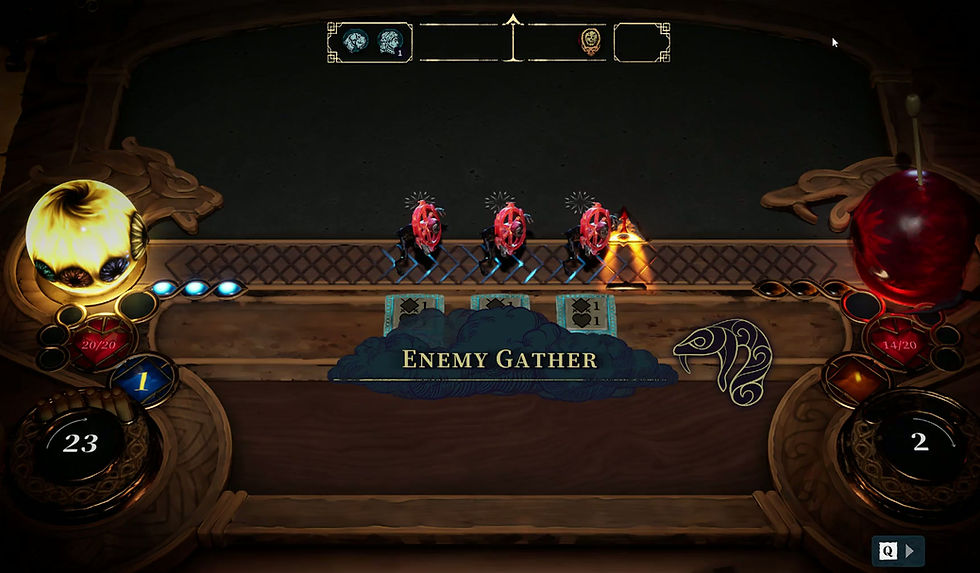
Players often reported Spark as a favorite card (always a good sign when folks remember a card by name, thank you to the fine folks at The Dive Down!) It gave them the one extra point of damage to end a tense boss battle or finish off a Lethal “The Fixer”. That feeling was too golden to lose just to make enemy decks more efficient. I even redesigned Black Milk's familiar boon (one of three bonuses players take with them on any ritual) to grant Sparks on discard - that way players always have one when they need it.

Keeping these direct damage cards but reducing their frequency in enemy decks gave them enough tools to preserve their difficulty. I filled the missing spots with creatures matching the mechanical theme and power level of the removed cards. For example, in keeping with Scorched Earth's theme of "deal pain at any cost to myself" I replaced additional copies of Thorns with Decaying Husks - creatures that damage themselves and all neighbors (regardless of allegiance) each turn.
These changes and many other balance fixes addressing player feedback launched with TKS's second Early Access Update: here.